The Illusion Economy
How Adult Platforms Sell Intimacy Without Crossing the Line

There is a quiet truth sitting underneath the modern internet economy that most people feel but rarely articulate, and it is this: we are no longer buying content, we are buying proximity, and the adult industry—faster, sharper, and far more honest about human behavior than any other sector—has already built the most advanced systems for monetizing that proximity at scale, turning what used to be a transaction of images into a transaction of attention, emotion, and simulated connection that feels real enough to justify payment, but structured carefully enough to remain legally defensible.
What looks, on the surface, like simple adult entertainment is in reality a highly engineered behavioral funnel, one that begins not with the product itself, but with the construction of a persona—deliberately designed, visually calibrated, and psychologically tuned to trigger a specific response pattern in a specific type of user—because the product is no longer just the content behind the paywall, the product is the experience of access, the feeling that you are not just watching, but participating, not just consuming, but being acknowledged.
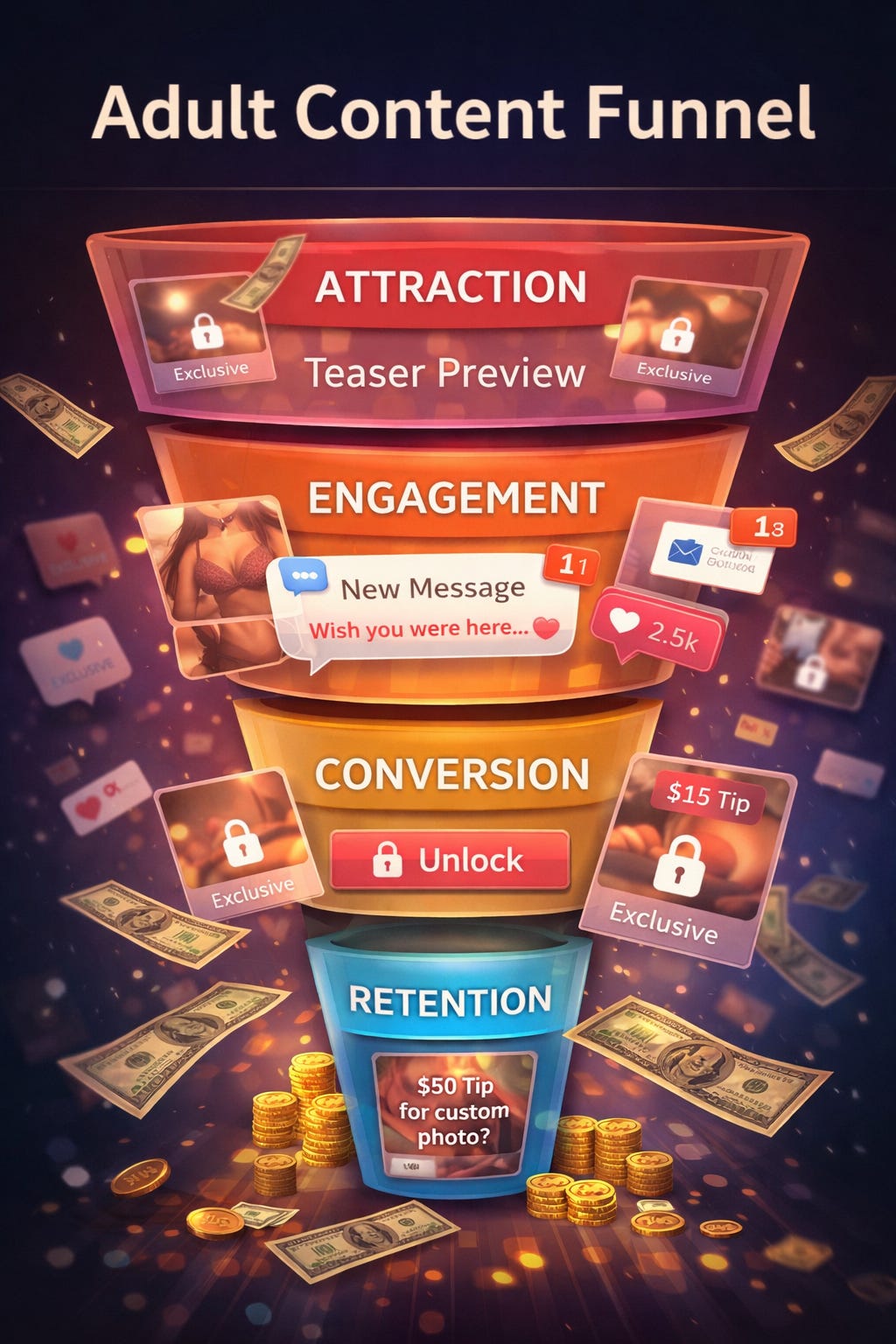
Platforms like OnlyFans and Pornhub have operationalized this model into a system that is deceptively simple on the front end and extraordinarily complex beneath the surface: you are given a glimpse, a teaser, a blurred image, a suggestive caption, a message that feels personal, and from that moment forward you are no longer navigating a website, you are moving through a funnel designed to escalate your level of engagement step by step, from curiosity to interaction, from interaction to transaction, and from transaction to repetition.
This is not accidental. It is architecture.
The first layer is attraction—thumbnails, bios, tone, and aesthetic signals that communicate exactly enough to draw the right audience without over-delivering. The second layer is engagement—messages that feel direct, immediate, and often intimate, even when they are structured, templated, or managed behind the scenes by teams or systems the user never sees. The third layer is conversion—paywalls, premium content, private interactions, each step offering not just more explicit material, but a deeper sense of access, a narrowing of the perceived distance between creator and consumer.
And here is where the system becomes both brilliant and controversial.
Because what is being sold is not strictly the content itself, but the illusion of intimacy—a carefully maintained ambiguity where the user is allowed, even encouraged, to feel special, to feel chosen, to feel like the interaction is uniquely theirs, while the platform avoids making any explicit claims that would legally bind that illusion into a promise, operating instead in a space where suggestion replaces declaration, where implication does the heavy lifting, and where the difference between fantasy and fact is never clearly defined, but never explicitly falsified.
That distinction is everything.
Because the entire system rests on a razor-thin boundary between persuasion and deception, and the difference is not aesthetic, it is structural. Marketing, even aggressive, emotionally manipulative marketing, is still built on a value exchange: you pay, and you receive something that aligns—at least broadly—with what you believed you were buying. Deception begins the moment that alignment breaks, when the user’s understanding of reality is materially different from what is actually being delivered, especially when that misunderstanding is the reason they chose to spend money in the first place.
Regulators like the Federal Trade Commission do not concern themselves with whether something feels manipulative; they concern themselves with whether a “reasonable consumer” is being misled in a way that affects their decision-making, and that is where the adult industry has, so far, shown a kind of calculated discipline—pushing right up to the edge of emotional influence without consistently tipping into provable misrepresentation.
This is why disclaimers, buried terms of service, and carefully worded language matter more than most users realize, because they create a legal buffer that allows platforms to operate in a space where messages may be scripted, interactions may be managed, and personas may be partially constructed, while still maintaining the position that the user was never explicitly promised something that did not exist.
But there is a line, and when it is crossed, the entire system changes.
If the persona becomes a materially false identity—if a user is led to believe they are interacting with a specific individual when they are not, in a way that directly influences payment—that is no longer marketing, that is misrepresentation. If there is no real product, no content, no deliverable, only an endless loop of extraction, that is not a funnel, that is fraud. And if the interaction is designed not to sell, but to entrap, to expose, or to punish—if the user believes they are engaging in a consensual transaction but is instead part of a hidden operation—that is not marketing at all, but a honeypot, a behavioral trap wearing the skin of a commercial experience.
The mechanics may look identical on the surface—profiles, messages, engagement loops—but the intent and the outcome redefine the entire system.
And this is the part most people miss.
Because we tend to evaluate these environments emotionally—asking whether they feel manipulative, exploitative, or authentic—when in reality the system is governed by something far more clinical: alignment between expectation and delivery. As long as the user receives something that fits within the range of what they reasonably believed they were paying for, the system holds. The moment that expectation is intentionally distorted in a way that drives payment or creates harm, the system breaks, and what was once marketing becomes something else entirely.
What the adult industry has built, whether consciously or not, is a blueprint for the broader digital economy, one where intimacy itself becomes a product layer, where attention is not just captured but cultivated, and where the most valuable commodity is not content, but connection—or at least the feeling of it.
And the uncomfortable question that follows is not whether this model is ethical, or even sustainable, but whether it is already expanding beyond its origins, quietly reshaping how all digital platforms think about engagement, identity, and value.
Because once you understand that the product is not what is shown, but what is felt, you begin to see the same architecture everywhere.
And by then, you are already inside the funnel.